Scale, noise, and sparse metadata
The collection and preprocessing system handled more than 700 million raw social-media records containing repeated tweets and retweets, weak or missing location metadata, non-Arabic content, automated posting, spam, explicit-content links, noisy Unicode, informal spelling, and dialectal Arabic.
An early location-filter experiment also exposed how sparse the platform metadata was: requiring known Jordan location metadata together with Arabic reduced a much larger raw stream to a small usable subset. Geolocation therefore combined multiple signals rather than relying on one field.
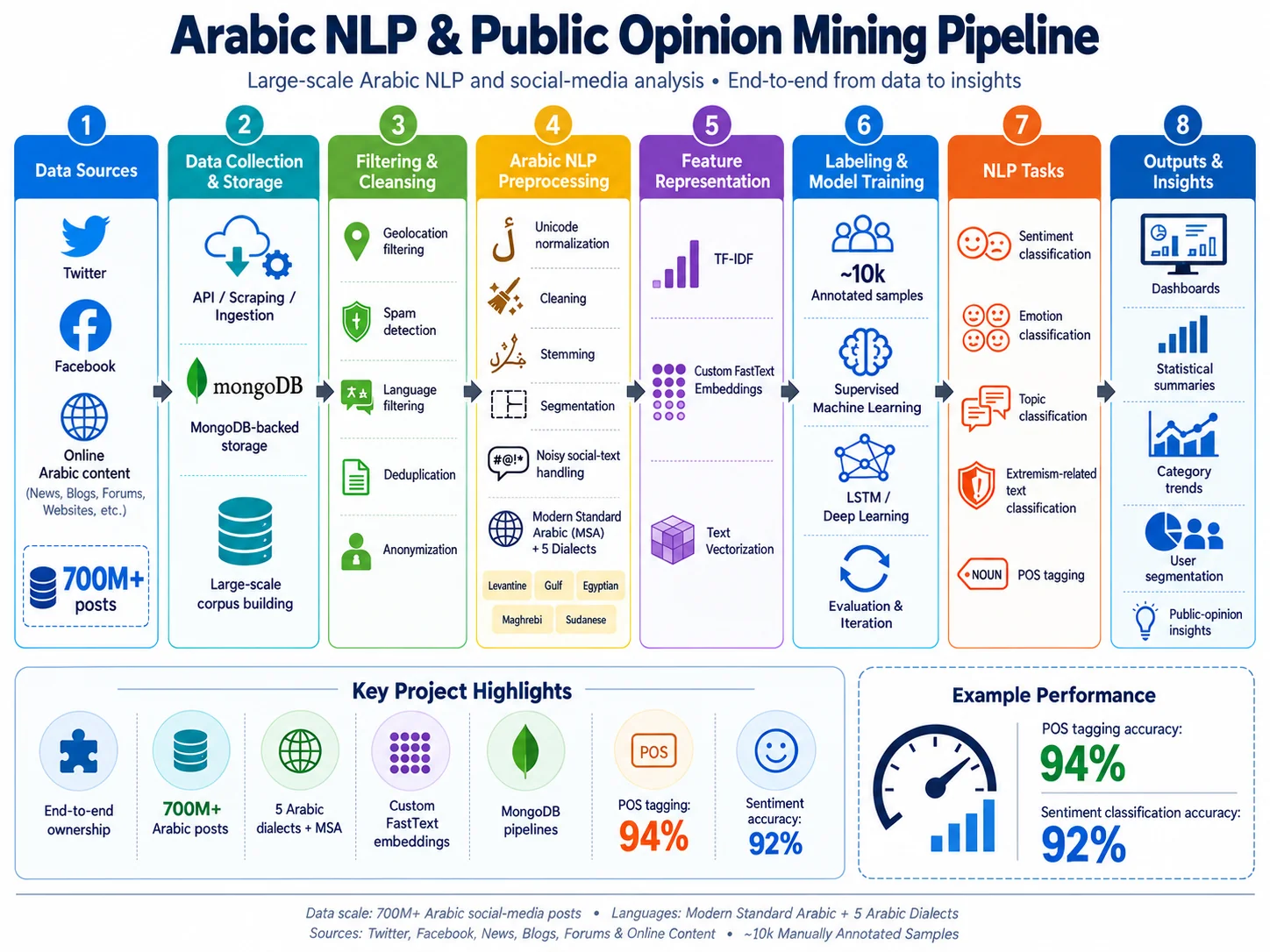
From raw stream to modeling corpus
Filtering before modeling
Source metadata, language signals, geolocation evidence, and explicit-content/link filtering reduced automated and contaminated traffic before downstream analysis.
Database-scale deduplication
MongoDB aggregation, batching, and disk-backed execution replaced per-document Python cleanup when working sets reached hundreds of millions of records.
Arabic-specific normalization
Presentation forms, ligatures, letter variants, tatweel, diacritics, punctuation, URLs, mentions, and other social-text artifacts were normalized or removed before segmentation and representation learning.
Dialect-aware representation
The wider NLP work covered Modern Standard Arabic and five dialects. FastText, Word2Vec, and TF-IDF were evaluated in the 2017-2018 modeling stack, with subword representations particularly suited to noisy spelling and out-of-vocabulary forms.
Modeling in the 2017-2018 context
The project predates transformer-based NLP becoming the practical default. Classical and neural approaches were compared across relevance, extremism-related categories, sentiment, emotion, and topic classification; FastText/Word2Vec and TF-IDF supported representation experiments, while LSTM-based models were selected for several downstream tasks after comparison.
Scope
This was collaborative research carried out in 2017-2018, and the analytical conclusions belonged to the wider project team. The collection, preprocessing, and NLP implementation described here is summarized from surviving project material without exposing raw social data, credentials, infrastructure addresses, or other private project material.