Represent document meaning as a graph
The prototypes explored whether relationships extracted from text could support retrieval cases that were difficult to express with conventional keyword matching alone. Documents were enriched with extracted entities, phrases, relations, and metadata, then represented as graph structures for downstream similarity and question-answering experiments.
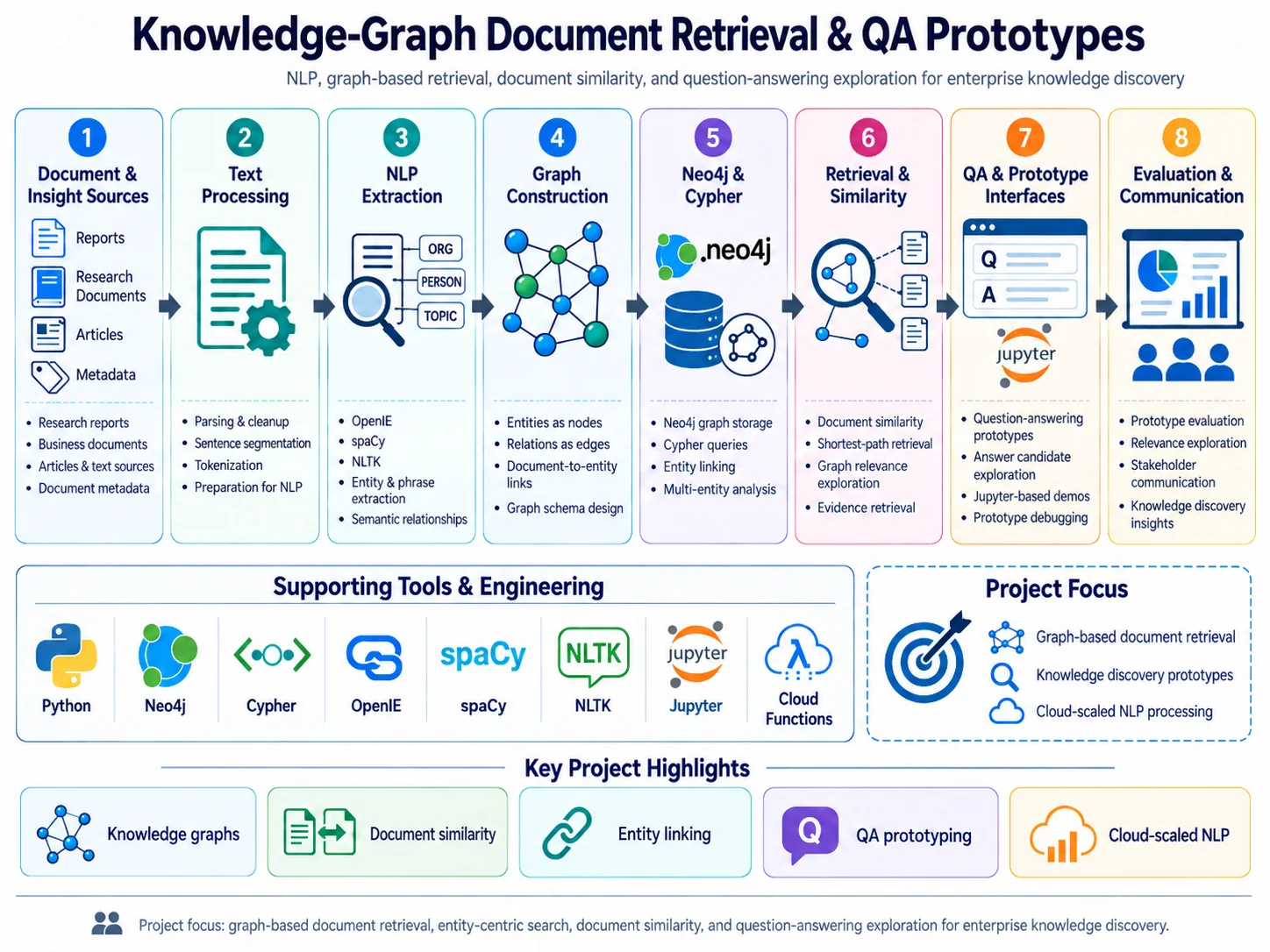
Graph-based retrieval and relevance exploration
Extraction
OpenIE-style relations, entity and phrase extraction, and document metadata supplied the nodes, edges, and context used by the graph representation.
Neo4j / Cypher
Cypher queries were used for entity linking, multi-entity phrase analysis, shortest-path retrieval, and graph-based relevance exploration.
Document similarity and QA
The graph representation supported prototypes for finding related documents and retrieving evidence candidates for question-answering workflows.
Prototype engineering and scale-up
Python NLP components were combined with Neo4j/Cypher and notebook-based interfaces used for debugging, demonstrations, and stakeholder communication. Cloud functions automated and scaled stages of the processing pipeline from raw document handling through graph-oriented retrieval experiments.
Scope and confidentiality
This page is a sanitized portfolio reconstruction based on surviving project material and my documented work. It does not reproduce proprietary corpora, customer data, internal product screens, confidential evaluation results, or an official company production architecture.